

Ask any hospitality operator what their biggest headache is, and "pour cost" will inevitably top the list. Every bar owner knows that inventory goes missing. We accept a little spillage here and an honest mistake there as the cost of doing business. But what if those minor leaks are actually a massive, silent drain on your bottom line?
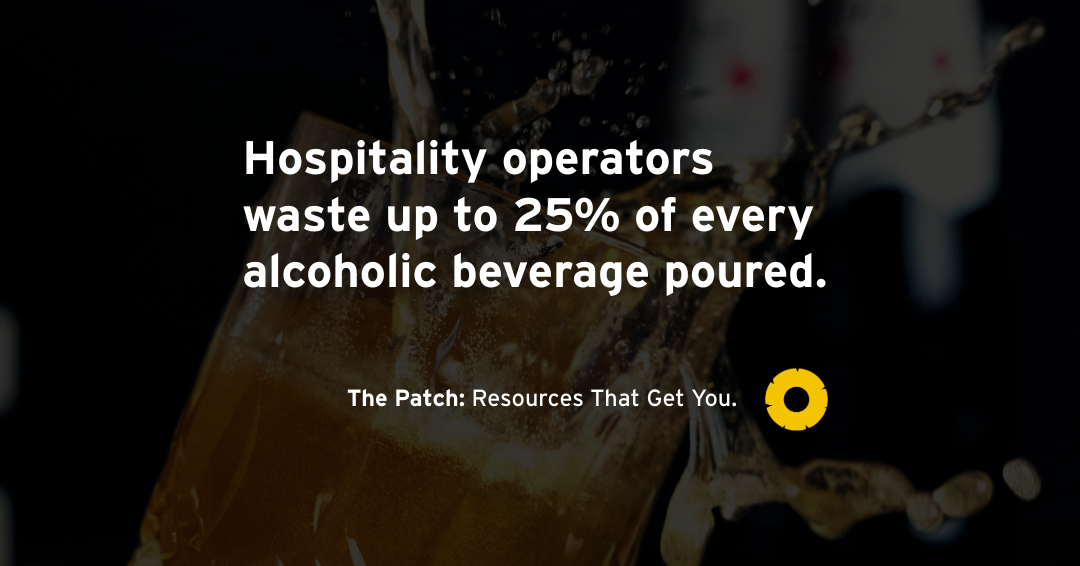
The reality of inventory shrinkage is staggering. According to industry data, the average bar loses 20% to 25% of its liquor inventory to shrinkage—driven by over-pouring, spillage, and drinks that simply never get run through the point-of-sale (POS) system.
Most operators are aware of this pain point, yet few take decisive action because manual inventory tracking feels like a second full-time job. Let’s break down exactly how much this is costing your venue and explore a no-brainer solution to plug the leaks permanently.
You’re Getting Hurt by Shrinkage
Liquor carries some of the highest gross profit margins in the food and beverage industry, usually hovering around 70% to 80%. Because of this premium markup, losing liquid isn't just about losing the wholesale cost of a bottle—you are losing the full retail value of an unmade sale.
Look at how quickly three everyday habits compound over a 300-drink weekend shift:
The "Generous" Free-Pour (Over-Pouring): A bartender counting in their head during a rush easily pours 1.75 oz instead of your standard 1.25 oz or 1.5 oz shot. Just 0.25 oz of extra liquor per drink gives away every 6th or 7th drink for free. Across 20 bottles a week, that single quarter-ounce overage drains more than 150 full bottles of spirits per year with zero revenue attached.
Drinks Never Rung Into the POS: Whether it is an honest mistake during a three-deep bar rush, an untracked "friend of the bar" buyback, a staff shift drink, or intentional theft, just 3 unrung drinks per night at a $9 average menu price drains $9,855 per year directly off your bottom line.
Spillage, Remakes & Drain-Off: Knocked glasses, wrong cocktail builds, and over-tilted spouts routinely waste 1 to 2 ounces per bottle—eating away another 2% to 4% of your gross margin before a single guest pays a tab.
How Much Are You Losing?
To calculate your exact figures, Pineapple Bytes provides a free, 60-second interactive Liquor Loss Calculator that maps out your real-world leakage based on your specific bottle usage and pricing.
How Do Berg Liquor Control Systems Connect?
BERG liquor control systems physically connect to your POS terminal using serial data links and specialized interface hardware to create a two-way communication channel. Instead of working as standalone equipment, the BERG system acts as a physical gatekeeper that explicitly syncs each poured ounce with a logged point-of-sale transaction.
The Pre-Check Method (Ring to Pour): The bartender inputs the order on the POS terminal first. The terminal pushes a command text file through the interface connection to the BERG controller, passing along the specific Price Look-Up (PLU) code. The BERG system receives the authorization and activates the pour ring or liquor gun, allowing exactly one portion to dispense.
The Direct Ring-Up Method (Pour to Ring): The bartender places the bottle into the activator ring and tips it. The BERG controller registers the action, dispenses the exact programmed amount, and immediately beams an automated PLU message back over the serial line, forcing the POS terminal to record the sale instantly on the open tab.
Is Berg Compatible with my Current System?
Because older platforms use localized databases and newer tablet systems require specific web APIs or hardware keys, you cannot simply plug a BERG unit into any random terminal. A certified technology dealer like Pineapple Bytes must physically map out your port availability, verify that your POS version supports beverage interface protocols, and load matching driver utilities to link the software together.
BERG liquor control systems are globally compatible with the vast majority of the top 10 hospitality and bar POS systems used across Canada today. Because BERG has been the industry standard for beverage tracking for decades, they maintain an extensive library of hardware interface drivers specifically built to communicate with Canadian hospitality networks.
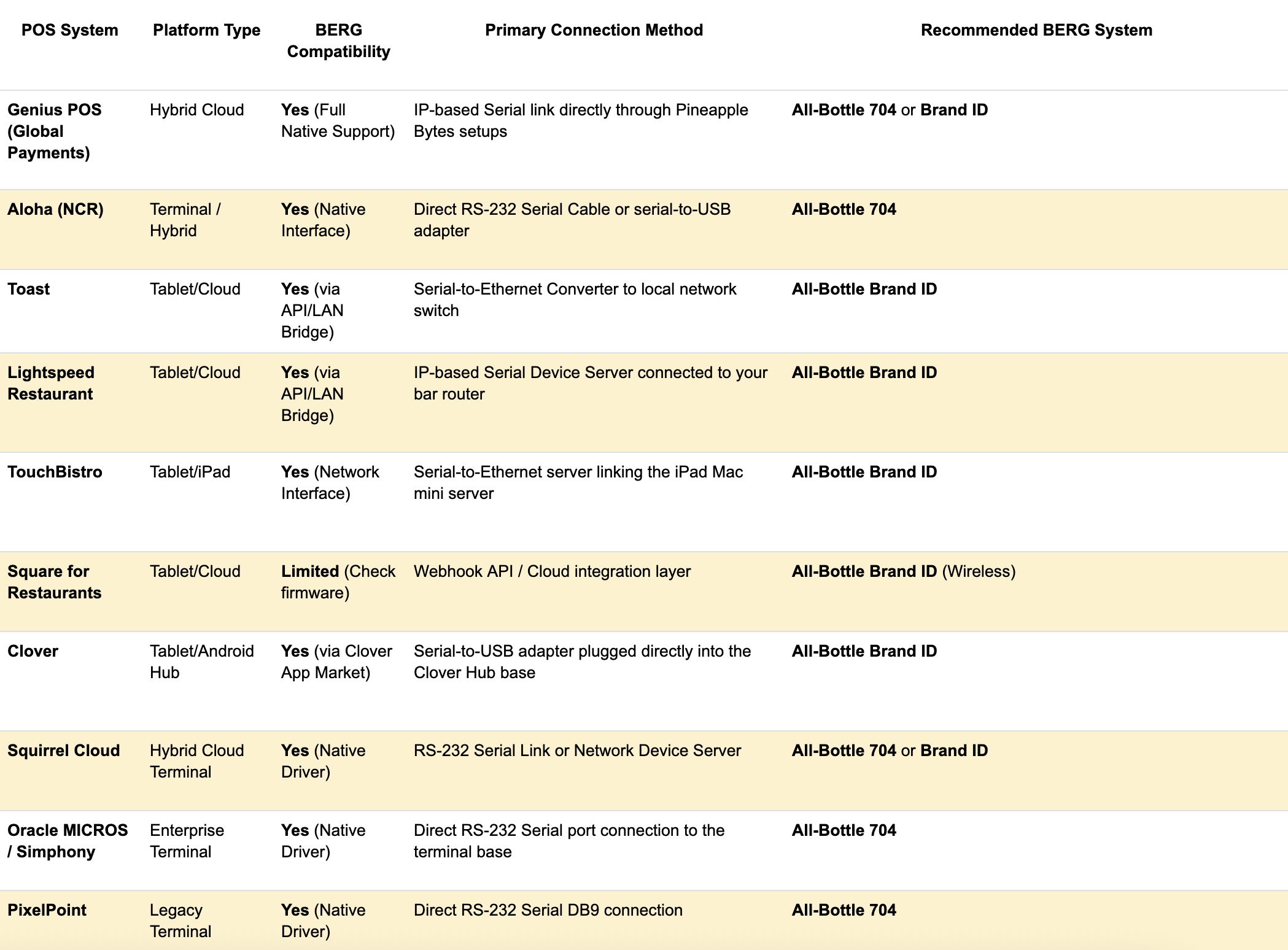
The table below breaks down the integration type, required connection method, and compatible BERG hardware options for the top 10 most common bar and restaurant POS systems by market share in English-speaking Canada:
Key Takeaways for Canadian Bar Operators
Tablet vs. Non-Tablet Users: For modern Android or iPad-based tablet systems (like Toast, Lightspeed, and TouchBistro), the BERG All-Bottle Brand ID system maps pours instantly over your local WiFi network, matching the specific brand poured to the open bill. For anchored, stationary terminals (like older Aloha or MICROS setups), the hardware-driven BERG All-Bottle 704 can bolt right on using direct physical cables.
Pineapple Bytes Ecosystem Support: Because Pineapple Bytes sells, services, and supports both Genius POS and Aloha POS alongside BERG control systems, they can configure these connections natively without requiring third-party software patches or unverified drivers.
Why Weekly Inventory Counting Doesn't Stop the Bleeding
When operators search Google or ask AI assistants how to lower their pour cost from 28% down to the industry target of 16%–18%, most software guides point them toward Bluetooth scales and inventory apps.
While counting inventory is important for accounting, counting bottles only tells you how much you lost after it’s already gone. It is an autopsy, not a cure. If your Sunday night count reveals you are missing four bottles of Tito’s and two bottles of Casamigos, you still can’t recover that cash—and accusing your entire bar team breeds resentment without solving the root mechanics of the pour.
To actually keep that 20%–25% margin in your bank account, you need proactive control at the point of dispense: a system where the bottle only pours an exact, pre-programmed portion, and every single pour is reconciled against your POS terminal in real time.
Frequently Asked Questions From Bar Operators
Won't my bartenders hate using a liquor control system?
Good bartenders actually prefer All-Bottle systems over manual jiggering once they use them for a shift. Why? Because it is faster than measuring by hand during a rush, produces consistent cocktails that result in fewer guest complaints, and removes the cloud of suspicion when inventory comes up short. When every pour is tracked automatically, honest staff never get blamed for someone else's heavy hand.
Do I have to be a Pineapple Bytes POS customer to get BERG liquor control?
No. Pineapple Bytes provides complete sales, custom bar design, installation, service, and 24/7 support for BERG liquor control systems whether you are an existing Pineapple Bytes customer or not. Whatever POS system currently sits on your bar counter, our hospitality specialists will configure the right BERG setup to match your workflow.
How long does it take for a BERG system to pay for itself?
Most bars and restaurants recover the entire cost of their BERG installation in 6 to 12 months (and high-volume venues often see full payback even faster). Once the system is paid off, that reclaimed 15% to 25% in liquor revenue flows straight to your net profit month after month.
Find Out Your Exact Amount of Alcohol Shrinkage Loss in 60 Seconds
You work too hard filling seats, managing food and labor costs, and building a great atmosphere to let a quarter of your highest-margin product disappear down the drain or walk out the front door unpaid.
Take 60 seconds right now to see what over-pouring, unrung drinks, and spillage are costing your bar every week:
Step 1: Run your numbers for free with the Pineapple Bytes Liquor Loss Calculator.
Step 2: Explore how our team designs, installs, and supports the BERG All-Bottle 704 and BERG All-Bottle ID across Canada at Pineapple Bytes Liquor Control Management Systems—or call us toll-free at 1 (877) 256-4226 to get a custom roadmap for your bar.