

downtime costs more than the sales you miss
Downtime costs are real and can be large. Network and POS failures are common enough that operators name them among their biggest disruptions. And when operators leave a POS provider, support quality appears next to technical failure as a reason. Downtime costs a restaurant or hospitality business the sales it cannot take while systems are down, plus idle labour, comped meals and refunds, and the guests who do not come back. No number or rule fits every business, so the honest answer is a formula you fill in with your own sales and staffing. Read on to learn how to calculate what an outage costs your business.
Lost tips and staff income
When payments stop, tips stop too. The Cincinnati pizzeria in the Square outage counted nearly $90 in lost tips on top of its lost sales (Restaurant Business). That money belongs to your team, not your till, and it shows up in morale.
Delivery and online orders
During the 2022 Rogers outage, the Canadian Federation of Independent Business said owners could not take online orders, use delivery apps or process debit and credit payments (Global News). A restaurant with a busy online channel can lose a second revenue stream at the same moment as the first.
Comps, goodwill and the guests who leave
You comp the table that waited. You refund the order that never printed. Some guests simply walk out. One retail customer of ours put it plainly in a ticket survey: "Customers were lost due to the outage." [Permission required before publishing this quote; attribute it to "a retail customer."]
Reviews and reputation
A bad night online lasts longer than a bad night in the dining room. A Harvard Business School study found each added Yelp star translated to a 5 to 9 percent effect on revenue, with the greatest effect for independent restaurants and chains largely unaffected (Harvard Business School). The study is about ratings in general and dates from Yelp's early years. It does not say how much one outage moves a rating. It does suggest why independents have more to lose from a public bad experience than chains do.
Staff stress and mistakes
Outages turn servers and cooks into troubleshooters at the worst moment, and manual workarounds create errors. That is our reasoning from how service works, not a study result, but ask any manager who has run a rush on paper tickets.
The knock-on cost of a slow answer
Every minute you spend on hold or waiting for a callback is a minute your fallback plan is carrying the load. The next section looks at why that matters.
Where poor support turns a short outage into a long one
An outage has a cause and a clock. The cause might be a router, a printer, an internet line or a software fault. The clock is how long you are down, and support quality controls most of it. In the TouchBistro survey of Canadian full-service operators who had bought or switched a POS in the past year, 53% cited technical issues with their current provider and 46% cited lack of customer support as reasons (TouchBistro). Support was named by nearly as many operators as technical failure, though the survey does not say which mattered more. The report is from a POS vendor, and the figures are survey answers, not measurements of outages.
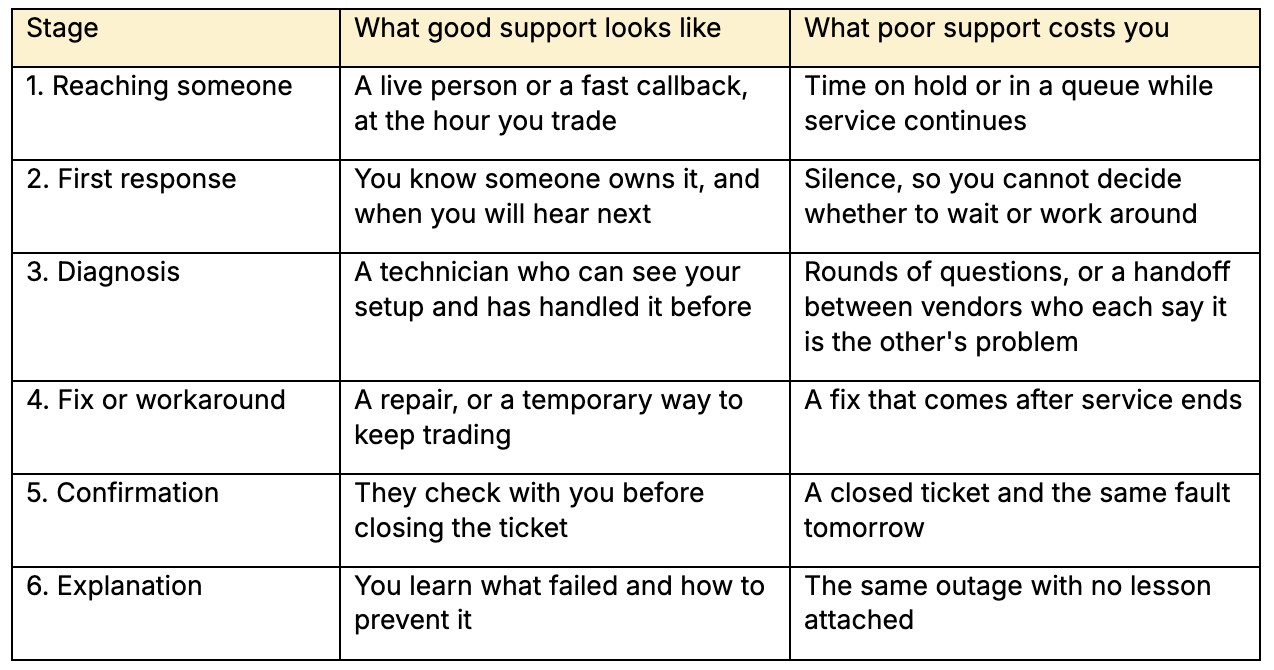
Where the clock runs during an outage
This table is our framework, built from how outages unfold in service.
Three ways poor Tech support makes it worse
It adds time you cannot trade through. Hold time, missed callbacks and slow first responses stretch the outage, and your fallback carries the load the whole time. That is our reasoning from how service works. The 2023 Square outage shows what hours of lost payments look like for one restaurant: at least $651 in sales and nearly $90 in tips, and the owner noted the figure "doesn't account for all the lost business" (Restaurant Business).
It leaves you without a plan. Only 20% of the quick-service operators in the QSR and Global Payments survey were very confident their POS could keep running if the network connection were compromised (QSR). A support partner who tells you in advance what your fallback is, and tests it, changes that answer.
It repeats. If a ticket is closed before the problem is confirmed fixed, the next outage is the same outage. Our own ratings data, next, shows how often customers say exactly that.
What our own support data shows
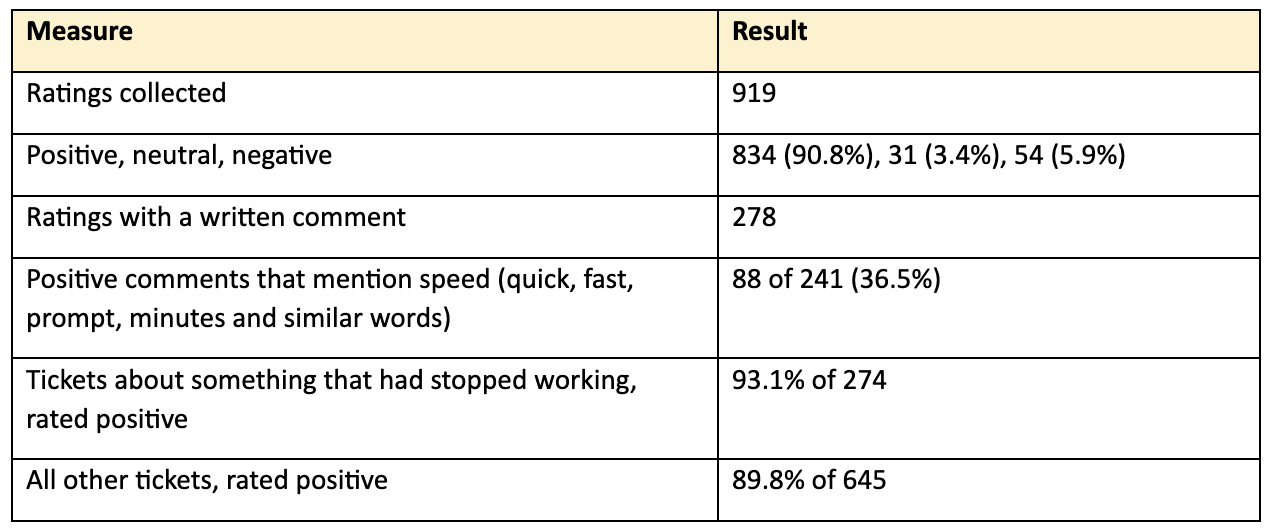
We looked at every post-ticket rating our customers left between March 22, 2024 and September 18, 2026.
Fast fixes earn praise; follow-through failures earn complaints
Tickets where something had visibly stopped working were rated more positively than other tickets, not less. Only 2.9% of them were rated negative, against 7.1% of the others. Our reading: when something is clearly broken and someone fixes it fast, customers say so. About a third of positive comments mention speed: "Fixed before I got off the phone. Thanks!"
Questions to ask any support provider before the next outage
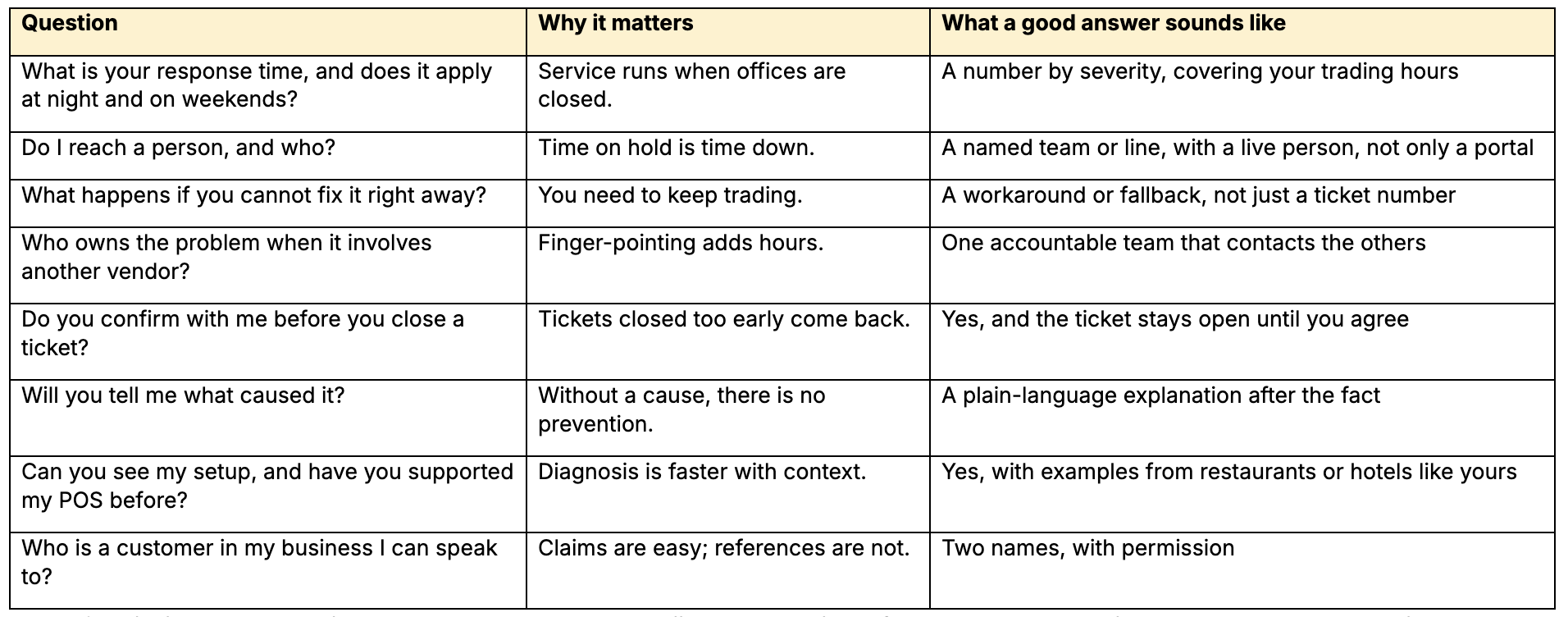
The themes in our own data, and the reasons operators gave for switching in the TouchBistro survey, point to the same short list. Ask these of your current provider and of any you are considering, including Pineapple Bytes.
Frequently asked questions about downtime and support in hospitality
How much does downtime cost a restaurant?
It depends on your sales, staffing and fallback, and no published figure fits every restaurant. The calculation is lost sales, idle labour, comps and refunds, and wasted product, multiplied by how often it happens. One Cincinnati pizzeria counted at least $651 in lost sales and nearly $90 in tips during a Square outage that kept operators from taking payments for hours (Restaurant Business).
How much does POS downtime cost per hour?
Your hourly sales at that time of day, times the share you cannot take, plus idle labour and comps. A restaurant doing $2,400 an hour at peak that can take none of it loses $2,400 in sales for each hour, before labour. That example is hypothetical. Use your own POS reports.
What causes POS downtime?
Common causes are internet or network failures, hardware faults such as printers, terminals or pin pads, and software or update problems. In the QSR and Global Payments survey, POS downtime and network or Internet outages were each named by 32% of operators among their top disruption causes (QSR).
How can a restaurant reduce downtime?
Keep systems updated, monitor the network and devices, standardize equipment across locations, set up a backup internet connection if you can, and have a written outage plan. The playbook above lists the steps.
What should I do when my POS goes down?
Note the start time, call support and ask who owns the issue, switch to your manual process if the fix will not be quick, and keep a log. Afterward, confirm the fix, ask what caused it and update your plan.
Does IT support quality really matter during an outage?
Yes. Support controls how long you wait for a response, whether anyone explains the cause and whether the same fault returns. In the TouchBistro survey, 46% of operators who bought or switched a POS in the past year cited lack of customer support as a reason, next to 53% who cited technical issues (TouchBistro).
How fast should IT support respond to a POS outage?
We are not aware of a verified industry standard, so ask for a written response time by severity and by hour of day. An outage during service is a different situation from a slow request at 2 p.m., and your agreement should say so.
How to calculate what an outage costs your business
You can estimate the cost of an outage in four lines, using numbers you already have. The formula is ours, not a published standard.
Lost sales = sales per hour at that time of day × hours down × the share of sales you cannot take. If you can still take cash or run orders by hand, the share is lower than 100%.
Idle labour = staff on the clock × their hourly cost (wage plus payroll costs) × hours down.
Comps and refunds = meals you gave away, orders you refunded and fees you were charged.
Wasted product = food made or products handled that could not be sold.
Add the four. Multiply by how many outages you have in a year. Then add the costs on the next section, which are harder to count.